Almost everyone knows exercise is good for them. And almost everyone who has tried to "start working out" knows the pattern: a burst of enthusiasm, a punishing first week, a missed day, then the slow fade into the old routine. The problem is rarely willpower. It is the design of the routine itself — built for someone's ideal week instead of their actual life.
Building an exercise routine you'll actually stick to is a different skill from exercising hard. It is about starting small enough that showing up feels easy, mixing the right kinds of movement, scheduling it like anything else that matters, and planning for the days that go wrong. This guide gives you a realistic framework for doing exactly that — no gym required, no six-week transformation promises.
Bodyweight exercises at home are enough to get started — no gym membership required.
Key Takeaways
- Consistency beats intensity: a modest routine you repeat for years outperforms a brutal one you quit in three weeks.
- The widely cited general guideline for adults is at least 150 minutes of moderate aerobic activity per week, plus muscle-strengthening on two or more days — a target to work toward gradually, not a starting point.
- A balanced routine mixes three ingredients: aerobic (cardio) movement, strength work, and flexibility or mobility.
- Scheduling workouts like appointments and tracking something simple dramatically improves follow-through.
- Missed days are normal — the only failure is treating one missed day as the end of the routine.
Why Routines Beat Motivation
Motivation is unreliable: it spikes on Monday mornings and vanishes on rainy Thursdays. Routines work because they remove the daily decision. When exercise happens at the same time, in the same place, with the same trigger (after coffee, before the evening news), it stops being a debate and starts being a habit — like brushing your teeth. Research on habit formation consistently suggests that behaviors tied to stable cues and done regularly become easier over time. The goal of your first month is not fitness; it is automation. Fitness follows.
What "Enough" Exercise Looks Like
It helps to know the target you are working toward. Public health authorities including the World Health Organization and the CDC generally recommend that adults aim for at least 150 minutes of moderate-intensity aerobic activity per week (brisk walking, cycling, dancing — anything that raises your heart rate while still allowing conversation), plus muscle-strengthening activities on two or more days that work the major muscle groups. Some flexibility and balance work, especially for older adults, rounds it out.
Important framing: that is a destination, not a starting line. If you currently do very little, even small amounts of activity are associated with health benefits — the biggest gains come from going from nothing to something. Work up gradually over weeks or months, and check with your doctor first if you have a chronic condition or have been inactive for a long time.
Build Your Routine in 5 Steps
Step 1: Start Smaller Than You Think
Choose a starting commitment that feels almost too easy — a 15-minute walk three times a week, or ten minutes of bodyweight exercises on two mornings. The point is to build a perfect attendance streak, not to test your limits. When two weeks of consistency feel boring, add a little. Starting small protects you from the two biggest routine-killers: soreness that makes you dread the next session, and sessions so long they are the first thing sacrificed on a busy day.
Step 2: Mix Cardio, Strength, and Flexibility
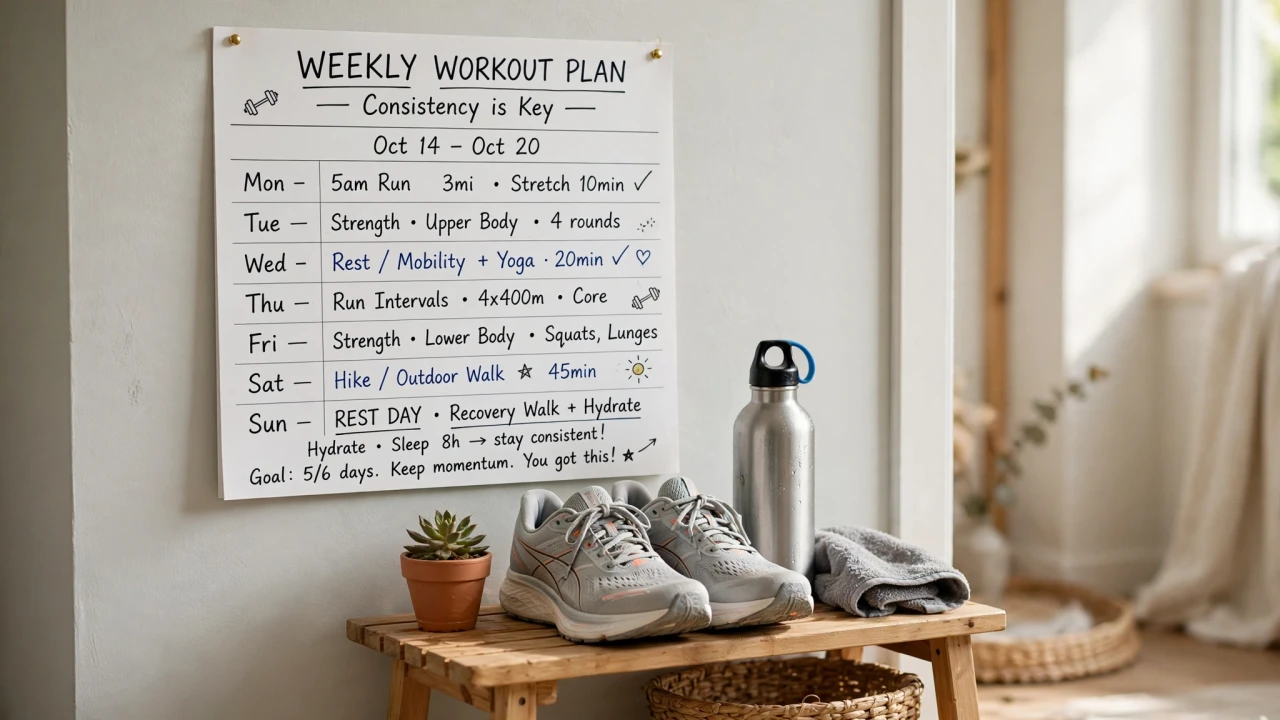
A well-rounded routine needs three ingredients. Aerobic movement (walking, jogging, cycling, swimming, dancing) supports heart health and endurance. Strength work (bodyweight exercises like squats and push-ups, resistance bands, or dumbbells) helps preserve muscle and bone — especially valuable as we age. Flexibility and mobility (stretching, yoga, or simple joint-mobility routines) keep movement comfortable. You do not need all three every day: a sample week might be walking on Monday/Wednesday/Friday, bodyweight strength on Tuesday/Thursday, and a stretch session on Saturday.
Brisk walking is one of the easiest ways to cover the weekly activity guideline.
Step 3: Put It on Your Calendar
Workouts that live only in your head are the first casualty of a busy day. Schedule each session like an appointment — day, time, and what you will do ("Tuesday 7:00 a.m., 20-minute walk + squats"). Attach it to an existing anchor where possible: a walk right after lunch, strength work before your morning shower. Decide the night before what you will wear and where you will go, so morning-you has nothing to negotiate.
Step 4: Track Something Simple
What gets recorded gets repeated. A wall calendar with an X on every workout day, a basic checklist on your phone, or a fitness tracker counting steps — pick whatever you will actually maintain. Track consistency, not performance, at least at first: days completed matters more than distance or speed. Watching the streak grow is its own reward, and it gives you honest feedback when life starts interfering.
Step 5: Plan for the Missed Days
You will miss days — travel, illness, deadlines. The difference between people who stick with exercise and people who quit is not discipline; it is a re-entry plan. Decide now: after any interruption, your next session will be short and easy, no "making up" the missed work. One missed week becomes nothing if the next session is Tuesday at 7 a.m. as usual. Never let a missed day become a reason to redesign the whole routine — just resume.
Staying Motivated Without Burning Out
Even with a good system, motivation needs feeding. Pair exercise with something enjoyable — a podcast, music, a friend, a scenic route. Progress at your own pace, adding a few minutes or a little difficulty only when the current level feels routine. Notice non-scale wins: sleeping better, climbing stairs without getting winded, mood lifting after a walk — these arrive long before visible body changes and are legitimate reasons to continue. And give yourself full permission to swap activities: if running bores you, dance, swim, cycle, or hike. The best exercise is genuinely the one you will keep doing.
Common Mistakes That Kill Routines
Doing too much too soon. Launching with an hour of intense training guarantees soreness and dread. Ramp up gradually. All-or-nothing thinking. A 10-minute walk is infinitely better than skipping because you "can't do the full workout." No scheduled time. "Sometime today" usually becomes never. Chasing soreness or sweat as proof. Effective training often feels moderate, not punishing. Changing the plan constantly. Jumping between programs every two weeks prevents the habit from forming — give any routine at least a month. Treating exercise as punishment for food. That framing poisons both habits; exercise is for strength, energy, and mood.
Scheduling workouts like appointments makes consistency far more likely.
Exercise Myths vs Facts
- Myth: You need a gym membership or expensive equipment.
Fact: Walking, bodyweight exercises, and simple resistance bands cover the essentials at almost no cost. Fancy equipment is optional, not required. - Myth: Workouts only count if they last an hour.
Fact: Shorter bouts of activity count too — and ten minutes of brisk walking is a legitimate building block. Accumulating movement across the week is what the guidelines measure. - Myth: Cardio alone is enough.
Fact: Aerobic activity is valuable, but strength work protects muscle and bone in ways cardio cannot. The guidelines recommend both for a reason. - Myth: "No pain, no gain" — soreness means it worked.
Fact: Muscle soreness is a poor measure of progress and a great way to get discouraged. Consistency over months is what produces results, not any single painful session.
When to See a Doctor
Exercise is one of the healthiest things you can do — but get medical guidance first in these situations:
- Chest pain, pressure, or unusual shortness of breath during exertion — stop and seek prompt medical evaluation.
- Dizziness, fainting, or heart palpitations related to activity.
- A chronic condition (heart disease, diabetes, high blood pressure, arthritis, asthma) or you have been completely inactive for a long time — ask your doctor how to start safely.
- Joint pain that persists or worsens rather than easing as you warm up — a clinician or physical therapist can sort out whether the issue is form, load, or something that needs treatment.
- Pregnancy or recent childbirth — general activity is often encouraged, but get personalized advice on what suits your situation.
This guide is general information, not a personal exercise prescription. If anything during activity feels wrong, stop and get checked.
Sponsored: check today's offers on recommended wellness products
Frequently Asked Questions
How long before I see results?
Mood, sleep, and energy often improve within a few weeks of regular movement; visible fitness changes typically take a couple of months of consistency. Measuring "results" too early is one of the fastest ways to quit — track attendance first.
Is it better to exercise in the morning or evening?
The best time is the one you will repeat. Morning sessions anchor the habit for many people and are less likely to be crowded out; evening sessions suit others better. Consistency beats the clock.
Should I exercise when I'm sore?
Mild soreness usually eases with gentle movement — a light walk or easy session is fine. Sharp pain or soreness that limits normal movement is a signal to rest and, if it persists, get checked.
Can I split my workouts into shorter sessions?
Yes. The guidelines count total weekly activity, so two 15-minute walks can serve the same purpose as one 30-minute session. Shorter sessions are often easier to fit into real days.
Do I need rest days?
Yes — recovery is when your body adapts and gets stronger. Alternate harder and easier days, and schedule at least one or two lighter or rest days per week. Constant intensity without recovery leads to burnout and injury.
Disclaimer: This article is for general information only and is not medical advice. Exercise needs and risks vary by individual — consult a qualified healthcare professional before starting a new exercise program, especially if you have a health condition or have been inactive.
What is the one small workout you could repeat three times this week? Tell us your plan in the comments — then go do day one.






Comments
Post a Comment