Eggplant has a reputation problem. Many people have met it only as a soggy, oily slice in a dish they did not enjoy, and they have avoided it ever since. Yet eggplant is one of the most versatile vegetables in the kitchen: it can be roasted until smoky and soft, grilled over open heat, simmered into stews, blended into dips, or stuffed and baked as a main dish. Across Mediterranean, Middle Eastern, Indian, and East Asian cooking, eggplant has been a staple for centuries, and cooks in all those traditions share the same understanding — eggplant rewards the right method, and punishes the wrong one.
Eggplant is also a genuinely useful food. It provides fibre, potassium, and small amounts of several vitamins and minerals, along with plant compounds that give its skin its deep purple colour, all for very few calories. This guide explains what eggplant offers, how it may support general health as part of a varied diet, and the simplest ways to choose, prepare, roast, grill, and stuff it, including the tricks that keep it from turning bitter or greasy.
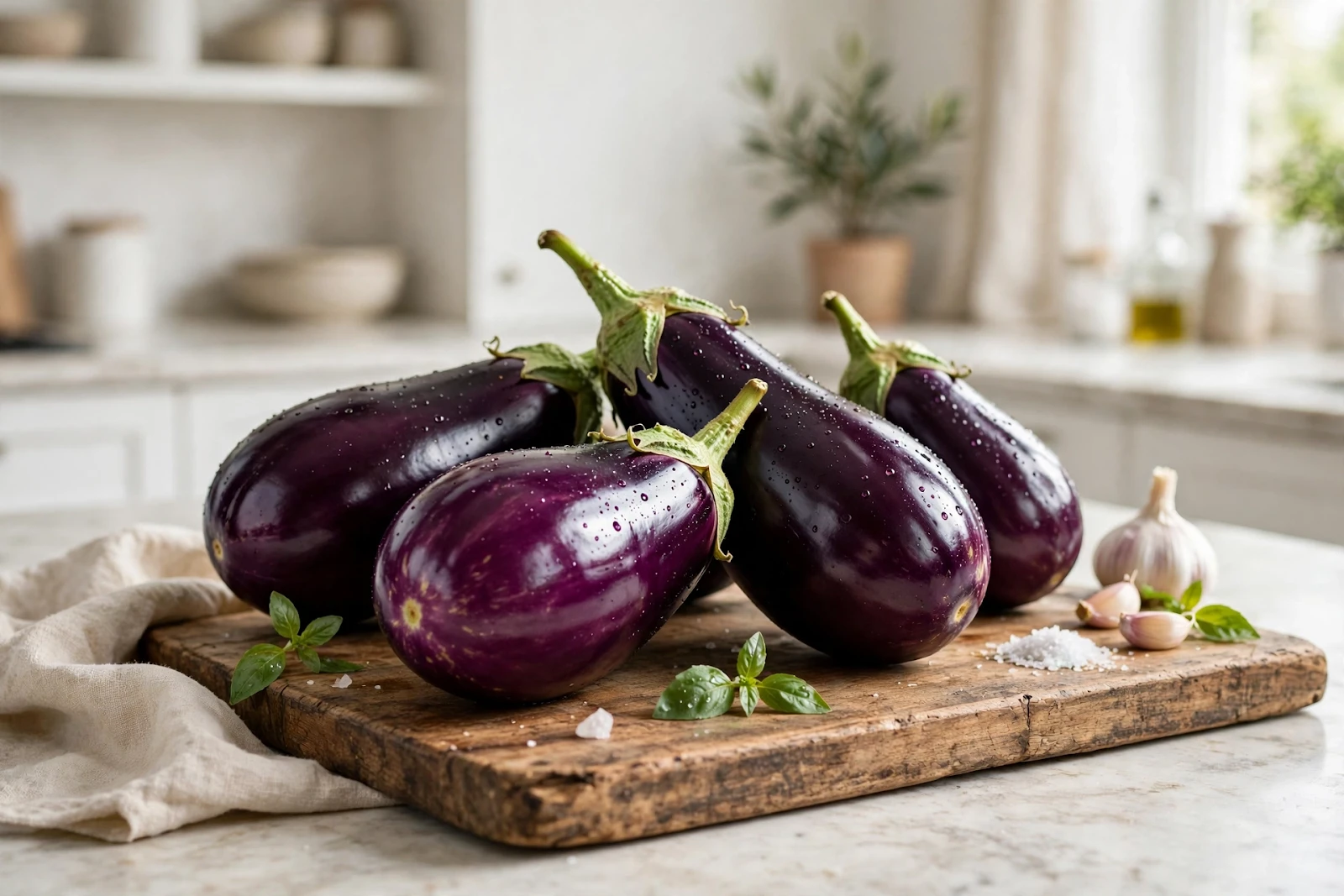
Fresh eggplants, firm and glossy, are ready for the pan.
Key Takeaways
- Eggplant is low in calories and provides fibre, potassium, and antioxidants, including the purple pigment nasunin in its skin.
- Its fibre may help meals feel satisfying and support digestive comfort as part of a balanced, vegetable-rich diet.
- Salting, high heat, and not overcrowding the pan are the keys to eggplant that is creamy inside, not bitter or greasy.
- Roasting, grilling, and stuffing suit eggplant best, while dips and stews welcome its soft, melting texture.
- People with certain sensitivities should note that eggplant belongs to the nightshade family; anyone with concerns should discuss them with a clinician.
1. What Eggplant Is and Why It Deserves a Second Chance
Eggplant is the fruit of a plant in the nightshade family, related to tomatoes, peppers, and potatoes. The most familiar type is the large, glossy purple variety, but long thin Asian eggplants, small round Thai eggplants, and pale striped varieties all belong to the same family and cook in broadly similar ways. Inside, the flesh is pale and spongy, dotted with small soft seeds, and it darkens quickly once cut, which is normal and harmless.
Public health bodies such as the World Health Organization encourage diets rich in a variety of vegetables, and eggplant is a good example of why variety matters. A plate that includes eggplant alongside leafy greens, beans, and whole grains draws on different plant compounds and nutrients than a plate built from a single vegetable repeated. Eggplant is not a miracle food, and no single vegetable can carry a healthy diet on its own, but it adds real diversity to everyday meals, and it brings a texture — soft, rich, almost meaty when cooked well — that few other vegetables offer.
Eggplant also travels well across cuisines, which makes it easy to fit into meals you already cook. It can be roasted as a side dish, layered into a pasta bake, stirred into a curry, blended into baba ghanoush, or stuffed with grains and vegetables for a main course. Once you know a couple of reliable methods, eggplant stops being a vegetable you avoid and becomes a regular, low-effort ingredient.
2. Fibre, Potassium, and Steady, Satisfying Meals
Eggplant is a good source of dietary fibre, including soluble fibre, the kind that dissolves in water and helps meals feel satisfying. Health authorities such as the NHS and the Mayo Clinic consistently recommend fibre-rich foods as part of a balanced diet, and eggplant contributes to that pattern without adding many calories. A serving of roasted eggplant, a spoonful of eggplant dip, or a stuffed eggplant half all add fibre to the meal, and variety across the week matters more than any single serving.
Eggplant also provides potassium, a mineral involved in normal muscle function and in maintaining healthy blood pressure as part of an overall dietary pattern. Potassium is found across many plant foods, and eggplant adds to that everyday intake rather than replacing other sources. Because eggplant is naturally low in sodium and fat, it fits easily into meals built around vegetables, legumes, whole grains, and unsaturated fats — the pattern that population studies consistently link with better general health.
There is a practical point worth knowing. Because eggplant is high in fibre and water, a very large serving can cause gas or bloating in some people, particularly if they are not used to high-fibre foods. Starting with a modest portion and increasing gradually is a sensible approach, and drinking enough water through the day helps fibre do its work comfortably. Cooking does not remove the fibre, so portion size, rather than cooking method, is the main lever here.
3. Antioxidants in the Purple Skin
The deep purple colour of eggplant skin comes from plant pigments called anthocyanins, including one known as nasunin. Anthocyanins are antioxidants, compounds that help protect cells from everyday oxidative stress, and they are the same family of pigments that colour blueberries, blackberries, and red cabbage. Studies suggest that diets rich in anthocyanin-containing foods are associated with better general health, though researchers are careful to note that overall dietary patterns matter more than any single compound.
The practical lesson is simple: keep the skin on when you can. Peeling eggplant removes much of its anthocyanin content along with some fibre, and the skin also helps slices hold their shape during cooking. For roasting, grilling, and stuffing, the skin is an asset, not a problem. If a recipe calls for peeled eggplant, such as a very smooth dip, that is fine too — the flesh still provides fibre and potassium — but for most everyday cooking, leaving the skin on is the better choice.
What eggplant cannot do is treat or prevent disease on its own. Laboratory studies on eggplant extracts sometimes make headlines, but concentrated extracts are not the same as eating eggplant as part of a meal, and this article makes no claim that eating eggplant will lower cholesterol, protect the heart, or treat any condition. It is the overall pattern — a diet rich in vegetables, legumes, whole grains, and unsaturated fats — that does the work, and eggplant is best enjoyed as one member of that pattern.
4. Bitterness and Greasiness: Two Problems with Simple Fixes
Two complaints dominate eggplant cooking, and both have straightforward explanations. Bitterness comes mainly from older, larger eggplants and from seeds that have matured. Greasiness comes from eggplant's spongy flesh, which soaks up oil like a sponge when it is cooked slowly in a crowded pan at low heat. Both problems are avoidable, and neither means eggplant itself is at fault.
Salting is the classic fix for bitterness. Sprinkling sliced eggplant with salt and leaving it for about half an hour draws out moisture, along with some of the bitter compounds, and the slices are then patted dry before cooking. Modern eggplant varieties are bred to be less bitter than older ones, so salting is not always necessary, but it still helps with texture: salted, dried slices absorb less oil and crisp better. Choosing younger, smaller eggplants also helps, since large, over-mature fruits tend to be more bitter and seedy.
High heat is the fix for greasiness. Roasting or grilling at high heat, with the pieces in a single layer and enough space between them, lets moisture escape and the surface brown before the flesh can soak up excess oil. Brushing slices lightly with oil, rather than pouring oil into the pan, gives the same flavour with far less fat. Frying eggplant in a shallow pool of oil at low heat, by contrast, is the surest way to produce the soggy, oily result that puts people off.
Roasted eggplant turns soft, smoky, and golden at the edges.
5. Easy Ways to Cook It: Roast, Grill, Stuff, and Blend
Roasting is the best first method for eggplant newcomers. Cut the eggplant into thick slices or cubes, brush lightly with olive oil, season with salt, and roast at high heat in a single layer until the edges are golden and the centres are soft and creamy. Roasted eggplant is excellent on its own, tossed through grain bowls, layered into sandwiches, or scattered over salads, and it keeps well enough to reheat the next day.
Grilling works similarly and suits summer meals. Brush thick slices with oil, grill briefly on each side until marked and tender, and finish with lemon juice, herbs, garlic, or a yoghurt sauce. Grilled eggplant is a natural partner for other grilled vegetables, flatbreads, and grain salads. For a main dish, stuffing is hard to beat: halve eggplants, scoop out some flesh, fill with a mixture of grains, tomatoes, herbs, and cheese or beans, and bake until tender. The eggplant shell holds its shape, the filling stays moist, and the result feels generous without needing meat.
For dips, the approach reverses. Whole eggplants roasted or grilled until completely soft, with charred skin, can be scooped out and blended with tahini, lemon, and garlic into baba ghanoush, a smoky dip that keeps well in the fridge. In stews and curries, cubed eggplant simmered in tomato or coconut sauce melts into the dish and thickens it gently. One useful caution applies to every form: rinse canned or jarred eggplant products if they are packed in brine to reduce salt, and check labels for added sugar in prepared sauces.
6. How to Choose, Store, and Prepare Eggplant
Choosing good eggplant is mostly a matter of firmness and weight. Pick fruits that feel heavy for their size, with smooth, glossy skin and no soft spots, cuts, or brown patches. The flesh should give slightly when pressed but spring back; a fruit that stays dented is probably overripe. Smaller and medium eggplants tend to have fewer seeds and less bitterness than very large ones, and the green cap should look fresh, not dried out.
Preparation is simple. Rinse the eggplant and pat it dry. Cut it just before cooking, since the flesh darkens on contact with air, though the colour change is harmless. If you plan to salt it, slice first, salt, wait about half an hour, then pat dry thoroughly — surface moisture is the enemy of crisp results. If you plan to stuff it, halve it lengthwise and score the flesh so it cooks evenly and is easy to scoop.
For storage, keep uncut eggplant in the fridge, where it usually stays fresh for several days. A loose bag helps prevent moisture build-up, and cutting only just before cooking keeps it in better condition. Cooked eggplant keeps for a few days refrigerated and freezes reasonably well in cooked dishes such as stews and bakes, while dips keep well chilled for several days. Fresh eggplant is best in summer in many regions, but it is widely available all year.
7. Eggplant in a Balanced Week
The easiest way to enjoy eggplant regularly is to give it a fixed slot in the week rather than treating it as a special project. Roasted eggplant on one evening can become the base for grain bowls the next day; grilled slices can fill sandwiches at lunch; a stuffed eggplant can anchor a weekend dinner. Because eggplant pairs well with tomatoes, garlic, herbs, olive oil, yoghurt, and grains, it slots into Mediterranean-style meals without needing new ingredients or new skills.
Variety within the vegetable group matters too. Rotating eggplant with leafy greens, beans, root vegetables, and other colourful vegetables gives the diet a broader range of nutrients and plant compounds than repeating any single vegetable. Eggplant's contribution — fibre, potassium, and purple-skin antioxidants — complements rather than replaces what other vegetables offer, and that complementarity is the point.
Finally, keep expectations realistic. Eggplant is a nutritious, versatile vegetable, not a treatment, and enjoying it regularly as part of a varied diet is the sensible goal. Cook it well, keep the skin on when you can, use high heat and a light hand with oil, and it is likely to earn a regular place on the table.
Stuffed eggplant makes a satisfying main dish with very little effort.
Myths vs Facts
Myth: Eggplant is always bitter, so it is not worth cooking.
Fact: Bitterness comes mainly from older, larger fruits. Choosing smaller, firm eggplants and salting slices before cooking removes most of the bitterness, and modern varieties are bred to be milder.
Myth: Eggplant soaks up oil, so it is always unhealthy.
Fact: Eggplant only becomes greasy when fried slowly in a crowded pan. Roasted or grilled with a light brushing of oil, it stays creamy without absorbing excess fat.
Myth: You must peel eggplant before cooking.
Fact: The skin holds much of eggplant's purple-skin antioxidants and fibre, and it helps slices keep their shape. Keep it on for roasting, grilling, and stuffing.
Myth: Eggplant can lower cholesterol or treat heart disease on its own.
Fact: No food treats disease. A vegetable-rich dietary pattern is associated with better general health, but eggplant is not a treatment, and medication should never be changed based on food writing alone.
Myth: Eggplant is difficult to prepare.
Fact: Preparation takes minutes: rinse, cut, and cook. Roasting thick slices needs no salting at all with young eggplants, making it one of the simplest vegetable side dishes.
When to See a Doctor
Eggplant is a food, not a treatment, and this article is general information only. Consider speaking with a clinician or dietitian if you notice persistent digestive discomfort after eating eggplant, if you have symptoms such as swelling, itching, or difficulty breathing after eating it, if you have a known nightshade sensitivity and are unsure about eggplant, or if you have a digestive condition and are unsure about high-fibre foods. Seek prompt medical care for any severe allergic reaction.
Sponsored: check today's offers on recommended wellness products
Frequently Asked Questions
Is eggplant good for you?
Yes, as part of a varied diet. It provides fibre, potassium, and antioxidants from its purple skin, and it is naturally low in calories.
Do you need to salt eggplant before cooking?
Not always. Modern varieties are milder, but salting for about half an hour still helps with bitterness and texture, especially for larger eggplants, and it reduces oil absorption.
Why does eggplant sometimes turn out soggy?
Sogginess usually comes from low heat and crowding the pan. Roast or grill at high heat in a single layer, with space between pieces, so moisture escapes and the surface browns.
Should you eat eggplant skin?
Yes, when you can. The skin contains much of eggplant's anthocyanin antioxidants and fibre, and it helps slices hold their shape during cooking.
How long does fresh eggplant last in the fridge?
Uncut eggplant usually keeps for several days in the fridge. Once cooked, it keeps for a few days refrigerated, and dips keep well chilled for several days.
Eggplant rewards a little patience. Start with a tray of roasted slices one evening, try a stuffed eggplant the next week, and keep grilled slices in the fridge for quick lunches. Which way of cooking eggplant will you try first? Share your ideas in the comments below.
Disclaimer: This article provides general health information only and is not medical advice. It is not intended to diagnose, treat, cure, or prevent any condition. If you have a health concern or a specific dietary need, please consult a qualified healthcare professional.




Comments
Post a Comment