Walnuts are one of the most rewarding foods you can add to an everyday diet. With their rich, slightly bitter flavour and satisfying crunch, they turn a plain salad, a bowl of oatmeal, or a simple snack into something more interesting — and they bring a distinctive nutritional profile with them. Unlike most other nuts, walnuts are a notable plant source of omega-3 fats, and they are also rich in fibre, protein, and a range of plant compounds studied for their role in a varied diet.
This guide looks at what walnuts are, what makes them nutritious, how they may support your health as part of a balanced diet, how many to eat, and the simplest ways to enjoy them at home. Whether you keep a jar of shelled walnuts in the cupboard for snacking, scatter them over salads, or stir them into baking, you will find practical ideas that fit an ordinary kitchen and an ordinary week.
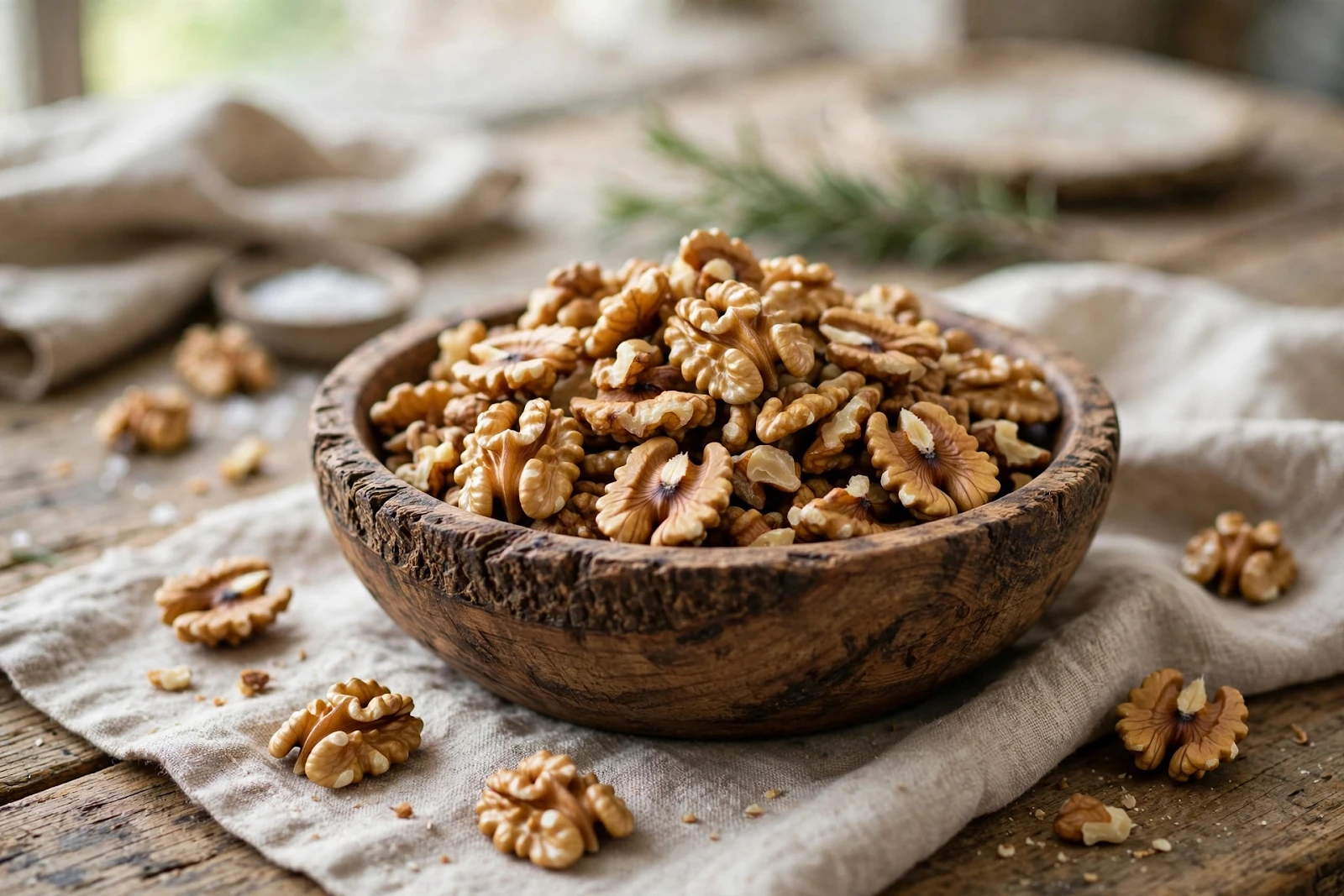
A small bowl of shelled walnuts is an easy, satisfying snack.
Key Takeaways
- Walnuts are tree nuts with a distinctive brain-like shape, sold in shells or shelled, raw or toasted.
- They are one of the few plant foods rich in alpha-linolenic acid (ALA), a plant omega-3 fat.
- Walnuts also provide fibre, plant protein, vitamin E, magnesium, copper, and manganese.
- A small handful a day — roughly 30 grams, or about a quarter of a cup — is a sensible everyday portion for most people.
- They work in salads, oatmeal, baking, sauces, and snacks, and keep best in a cool, airtight container.
1. What Are Walnuts?
Walnuts are the edible seeds of trees in the Juglans family, most commonly the English or Persian walnut, Juglans regia. The nut sits inside a hard, wrinkled shell, which itself sits inside a green husk while it grows on the tree. When you buy walnuts, you will usually find them either in the shell — a satisfying, old-fashioned option that keeps well — or shelled, as halves and pieces ready to eat or cook with.
Walnut halves are the classic choice for salads, baking, and snacking, while chopped walnuts and walnut pieces are handy for cooking, where a uniform size matters less. You may also see walnut oil, which has a delicate, nutty flavour best used in dressings and finishing dishes rather than high-heat cooking, and walnut butter, a spread similar in spirit to peanut butter. Whichever form you buy, walnuts have a rich, slightly bitter flavour that pairs naturally with apples, pears, cheese, honey, chocolate, and leafy greens.
Walnuts have been eaten for thousands of years around the Mediterranean, the Middle East, and Central Asia, and they remain a staple of those cuisines. They appear in salads and grain dishes, in cakes and pastries, and in savoury sauces such as the walnut sauces of Georgian and Middle Eastern cooking. Their staying power is easy to understand: they are filling, versatile, and keep for months when stored well.
2. What Makes Walnuts Nutritious?
Walnuts earn their healthy reputation mainly through their fats. Most of the fat in walnuts is unsaturated, including polyunsaturated fats and a meaningful amount of alpha-linolenic acid (ALA), a plant omega-3 fatty acid. ALA is not the same as the long-chain omega-3s found in oily fish, and the body converts only a small proportion of it, but walnuts are still one of the richest plant sources of it, which makes them especially useful for people who eat little or no fish.
Beyond fats, walnuts provide fibre and plant protein, which together help a snack or meal feel satisfying. A small handful offers a useful amount of fibre for relatively few mouthfuls, along with magnesium, copper, and manganese, and vitamin E in the form of gamma-tocopherol. They also contain plant compounds called polyphenols, including ellagitannins, which are studied for their possible role in a varied, plant-rich diet.
Like other nuts, walnuts are energy-dense, which means a small amount provides a fair number of calories. That is not a problem in itself — nuts are filling foods, and a small portion goes a long way — but it is a reason to think in handfuls rather than bowlfuls. As part of a diet built around vegetables, fruits, whole grains, legumes, and healthy oils, walnuts are a genuinely useful ingredient rather than a food to fear.
3. Walnuts and Heart Health
Walnuts are often discussed in connection with heart health, and the reasoning rests on their overall nutritional profile rather than any single ingredient. Diets rich in unsaturated fats, fibre, and plant foods, and low in saturated fat and excess sodium, are associated with better heart health in large population studies. Walnuts contribute unsaturated fats and fibre to such a pattern, and they can help replace less nutritious foods — for example, when a handful of walnuts replaces crisps as a snack, or walnuts in a salad replace a creamy, high-saturated-fat topping.
Studies suggest that eating nuts regularly, as part of a balanced diet, may help support healthy cholesterol levels, although results vary and no single food protects the heart on its own. Walnuts work best alongside the everyday habits that matter most: a balanced diet, regular physical activity, not smoking, and keeping blood pressure and cholesterol in check with professional advice where needed. Anyone managing blood pressure, cholesterol, or blood sugar should discuss dietary changes with a healthcare professional rather than relying on a single food.
For minerals, walnuts contribute magnesium and copper as part of the diet as a whole, and their naturally low sodium content — when bought plain and unsalted — is a genuine advantage over many processed snack foods. The practical point is that walnuts make heart-healthy eating easier and tastier, not that they are a treatment for any condition.
4. Walnuts, Fullness, and Balanced Eating
For appetite, walnuts have a practical advantage: the combination of fat, fibre, and protein in a small handful may help fullness last longer than a low-fibre snack of similar size. Compare a small handful of walnuts with a plain biscuit: the walnuts take longer to eat, feel more substantial, and are more likely to keep you satisfied until the next meal. Walnuts are not a weight-loss food on their own, but as part of a balanced meal or snack they can make steady, satisfying eating easier.
The same qualities make walnuts a useful addition to meals that might otherwise feel light. Scattering walnuts over a salad, stirring them into oatmeal, or adding them to a grain bowl adds staying power without any extra cooking, and without overpowering the dish. Pairing walnuts with fruit, vegetables, or whole grains, rather than eating them alongside refined, low-fibre foods, gives the most balanced result.
One note on portion: because walnuts are energy-dense, a small handful is usually enough. Pre-portioning a snack, rather than eating straight from a large bag, is a simple habit that keeps portions honest without any counting or weighing. If you are watching your overall calorie intake, walnuts still fit — they just fit in handfuls, not bowlfuls.
5. How Many Walnuts Should You Eat?
For most adults, a sensible everyday portion is about 30 grams of walnuts, which is roughly a small handful, about a quarter of a cup, or around 14 walnut halves. That amount provides the flavour and nutrition walnuts are known for without dominating the day's calories. Many dietary guidelines group nuts together and suggest a small daily handful as part of a balanced diet, and walnuts fit comfortably within that pattern.
Children can eat walnuts too, but whole nuts are a choking hazard for very young children, so chopped or ground walnuts, or walnut butter thinned with a little water, are safer options for toddlers — and any new food should be introduced with allergy in mind. People with a tree nut allergy must avoid walnuts entirely, and should check labels carefully, since walnuts can appear in baked goods, sauces, and mixed nut products.
Raw and toasted walnuts are both good choices. Toasting deepens the flavour and makes the texture crisper, which is lovely in salads and baking, but it is optional. Salted or candied walnuts are a different matter: the added salt or sugar changes the nutritional picture, so plain walnuts are the better everyday choice, with flavoured versions kept as an occasional treat.
Chopped walnuts add crunch and richness to a simple green salad.
6. Simple Ways to Enjoy Walnuts
As a snack. A small handful of plain walnuts, on their own or mixed with dried fruit, is one of the simplest snacks there is. Keep a jar in the cupboard and a small container in your bag for the afternoon stretch between lunch and dinner.
In salads. Scatter chopped walnuts over green salads, beetroot salads, or grain salads with a lemon and olive oil dressing. Their bitterness balances sweet ingredients such as apple, pear, grapes, and roasted squash.
On oatmeal and yoghurt. Stir walnuts into warm oatmeal with banana and a drizzle of honey, or sprinkle them over yoghurt with berries. The crunch contrasts beautifully with soft, creamy textures.
In baking. Fold walnuts into banana bread, brownies, muffins, and coffee cake, or press them into the top of a loaf before baking. Toast them lightly first for a deeper flavour.
In sauces and stuffings. Blend walnuts with herbs, garlic, olive oil, and a little lemon for a pesto-style sauce, or chop them into stuffings for roasted vegetables and poultry. Their richness gives savoury dishes extra body.
7. Easy Walnut Ideas for Everyday Meals
If you want to eat walnuts more often, keep the ideas simple. Keep a jar of shelled walnuts in the cupboard and add them to whatever you are already making, whether that is a salad, a bowl of oatmeal, or a tray of roasted vegetables. Make a batch of walnut-topped oatmeal on a weekend morning, or toast a tray of walnuts for the week ahead — toasted walnuts keep their flavour for days in an airtight container.
Storage matters more with walnuts than with many other nuts, because their unsaturated fats can turn rancid in warmth and light. Keep shelled walnuts in an airtight container in a cool, dark place, or in the fridge for longer storage, and in the freezer if you buy in bulk. A quick sniff tells you if they have turned: fresh walnuts smell mildly nutty, while rancid walnuts smell sharp and paint-like, and should be discarded.
Walnuts on warm oatmeal make an ordinary breakfast feel more complete.
Myths vs Facts
Myth: Walnuts are fattening, so you should avoid them.
Fact: Walnuts are energy-dense, but in small handful portions they are a filling, nutrient-rich food. Weight change depends on the overall diet and activity over time, not on a single food.
Myth: Walnuts are only good for the brain because they look like one.
Fact: The resemblance is a coincidence, but walnuts do contain plant omega-3s, vitamin E, and polyphenols studied in connection with brain health. They are one part of a varied diet, not a brain treatment.
Myth: All nuts have the same nutrition, so walnuts are nothing special.
Fact: Nuts share many qualities, but walnuts stand out for their plant omega-3 (ALA) content, which most other common nuts provide in much smaller amounts.
Myth: Toasted walnuts lose all their nutrition.
Fact: Light toasting changes flavour and texture and may slightly reduce some sensitive compounds, but toasted walnuts remain a nutritious food. Avoid very dark roasting and added salt or sugar.
Myth: You must eat walnuts every day to benefit.
Fact: Regular eating as part of a varied diet is what matters in population studies, but walnuts a few times a week still contribute useful nutrients. Consistency over months beats perfection on any single day.
When to See a Doctor
Walnuts are safe for most people as part of a varied diet, but a few situations deserve medical advice. If you have a tree nut allergy, or you notice itching, swelling, mouth tingling, or difficulty breathing after eating walnuts or other tree nuts, seek medical advice promptly and avoid walnuts entirely. People with digestive conditions that limit nuts, seeds, or high-fibre foods should follow the advice of their own clinician rather than general guidance.
Walnuts are high in fibre and fat, so a sudden large portion can cause digestive discomfort in some people. Start with a small handful and increase gradually if you are not used to eating nuts often. Persistent digestive symptoms, such as ongoing pain, bloating, or changes in bowel habits, are worth discussing with a healthcare professional rather than adjusting your diet alone. This guide provides general information only and is not a substitute for professional medical advice, diagnosis, or treatment.
Sponsored: check today's offers on recommended wellness products
Frequently Asked Questions
How many walnuts should I eat per day?
About 30 grams — a small handful, roughly a quarter of a cup or around 14 halves — is a sensible everyday portion for most adults.
Are raw or toasted walnuts better?
Both are good choices. Raw walnuts are the simplest option, while light toasting deepens flavour and crispness. Choose plain walnuts over salted or candied versions for everyday eating.
How should I store walnuts?
Keep shelled walnuts in an airtight container in a cool, dark place, in the fridge for longer storage, or in the freezer if you buy in bulk. Discard walnuts that smell sharp or paint-like.
Can children eat walnuts?
Older children can eat walnuts, but whole nuts are a choking hazard for very young children, so chopped or ground walnuts or thinned walnut butter are safer. Introduce any new food with allergy in mind.
Are walnuts gluten-free?
Yes, walnuts are naturally gluten-free. Check labels for cross-contact warnings if you have coeliac disease, especially for mixed nut products.
Do you already cook with walnuts, or are they new to your kitchen? Share your favourite way to enjoy them — scattered over a salad, stirred into oatmeal, or baked into banana bread — in the comments below.
Disclaimer: This article provides general health information only and is not medical advice. It is not intended to diagnose, treat, cure, or prevent any disease. If you have a medical condition, take regular medication, or have concerns about your diet, please consult a qualified healthcare professional before making changes.




Comments
Post a Comment