
Fennel Tea: Health Benefits and Simple Ways to Use It
Fennel tea is one of those quiet kitchen remedies that has survived for centuries without ever becoming a trend. Made by steeping the small, ridged seeds of the fennel plant in hot water, it produces a golden, naturally sweet infusion with a gentle liquorice-like aroma. In many households across the Mediterranean, the Middle East, and South Asia, a cup of fennel tea after a meal is simply part of the rhythm of the day — a small ritual that marks the end of eating and the beginning of rest.
Modern interest in fennel tea has grown as more people look for simple, caffeine-free drinks that fit into a balanced lifestyle. But what does the evidence actually say? The honest answer is encouraging but modest: fennel has a long history of traditional use for digestion, and early research suggests some of its compounds may help relax the gut and ease feelings of fullness. It is not a medicine, and it is not a cure for any condition. What it can be is a pleasant, low-cost addition to a healthy routine — provided you understand what it is, how to prepare it, and when to be cautious.
Key Takeaways
- Fennel tea is an infusion made from fennel seeds, not from the Florence fennel bulb sold as a vegetable — the two come from the same plant family but are used very differently.
- Its main aromatic compound, anethole, is thought to contribute to its traditional reputation for easing digestion and feelings of bloating.
- Research on fennel tea in humans is still limited, so most benefits are best described as "may help" rather than proven effects.
- Fennel tea is naturally caffeine-free, low in calories, and easy to brew at home with just seeds and hot water.
- It is not recommended in medicinal amounts during pregnancy, and it may interact with some medicines — check with a doctor if you are unsure.

Illustration: A cup of fennel tea with dried fennel seeds beside it on a wooden table.
1. What Is Fennel Tea?
Fennel tea is a herbal infusion made by pouring hot water over fennel seeds and letting them steep for several minutes. Despite the name, it is not a true tea: it contains no leaves from the tea plant, Camellia sinensis, and therefore contains no caffeine. It belongs to the same family of drinks as chamomile or peppermint infusions — warm, plant-based drinks enjoyed for flavour and comfort rather than stimulation.
The plant behind the drink is Foeniculum vulgare, a flowering member of the carrot family that grows wild around the Mediterranean and is now cultivated in many parts of the world. Fennel has been used in cooking and traditional medicine for thousands of years, appearing in the traditional medicine systems of India, China, and the Middle East, where it was commonly prepared after meals. That long history is part of its appeal, but history alone is not proof of effectiveness — it is a starting point for curiosity, not a substitute for evidence.
One common point of confusion is the difference between fennel seed tea and Florence fennel, the crisp white bulb sold in greengrocers. Both come from fennel plants, but they are different varieties grown for different purposes. Florence fennel, sometimes called finocchio, is cultivated for its swollen bulb, which is sliced raw into salads or roasted as a vegetable. Fennel seed tea, by contrast, is made from the dried seeds of the common fennel plant, which is grown for its aromatic seeds and feathery leaves. The bulb can be used to make a mild infusion, but the drink most people mean when they say "fennel tea" is the seed infusion, and that is what this article covers.
The flavour of fennel tea is distinctive but gentle. The seeds contain aromatic oils that give the drink a sweet, warm taste with a hint of liquorice or anise. Some people drink it plain, while others combine it with ginger, lemon, or mint. Because it is naturally sweet-tasting, many people drink it without adding sugar or honey, which keeps it a very low-calorie drink. That simplicity is part of its charm: two ingredients, a few minutes, and a cup that feels like a small act of care.
2. What Is Inside a Cup of Fennel Tea?
A cup of fennel tea is mostly water, and that is worth remembering — much of what any herbal infusion offers begins with hydration itself. Beyond water, the drink carries small amounts of the aromatic compounds found in fennel seeds. The best known of these is anethole, the compound responsible for the sweet liquorice aroma. Fennel seeds also contain other volatile oils, including fenchone and estragole, along with small amounts of plant compounds called flavonoids, which are found in many fruits, vegetables, and herbs.
Nutritionally, a plain cup of fennel tea contributes almost no calories, no fat, and no sugar, unless you add a sweetener. Fennel seeds themselves contain small amounts of minerals such as potassium, calcium, and iron, as well as vitamin C and fibre — but only tiny quantities of these transfer into the water during steeping. It would be misleading to describe fennel tea as a significant source of any vitamin or mineral. Its value lies in its flavour, its warmth, its lack of caffeine, and the traditional role it plays after meals, rather than in any nutritional density.
What makes fennel interesting to researchers is not its vitamin content but its volatile oils. Laboratory studies suggest that anethole and related compounds may have a relaxing effect on smooth muscle, including the muscles of the digestive tract. That observation lines up with the traditional use of fennel for digestive comfort, and it has led to a small number of human studies exploring whether fennel preparations may help with symptoms such as bloating or cramping. The evidence base remains thin, however, and most studies have been small or short, or have tested fennel in combination with other herbs, which makes it hard to attribute any effect to fennel alone.
It is also worth noting what fennel tea does not contain. It has no caffeine, so it will not interfere with sleep the way black or green tea can. It has no added sugars when brewed plain. And because it is made from a single ingredient, it is easy to know exactly what you are drinking. If you buy fennel tea bags, check the ingredients list: some blends include other herbs, and the proportion of fennel can vary from brand to brand.
3. Fennel Tea and Digestion
The most common reason people reach for fennel tea is digestion. Across many cultures, fennel seeds are chewed or brewed after a meal, and the tea is offered to guests as a digestive. This tradition is so widespread that it is easy to assume the benefit is well proven — but the scientific picture is more nuanced. What we can say is that fennel has a long traditional record, that its aromatic oils may help relax the muscles of the gut, and that small studies have found encouraging signals. What we cannot say is that fennel tea reliably treats indigestion or any digestive disorder.
One of the ways researchers think fennel may work is through its effect on smooth muscle. The digestive tract is lined with smooth muscle that contracts in waves to move food along. When those contractions become irregular or overly strong, people may feel cramping or discomfort. Laboratory research suggests that anethole, the main compound in fennel oil, may help relax this muscle tissue. If that effect carries over into the human gut, it could explain why a warm cup of fennel tea feels soothing after a heavy meal. This is a plausible mechanism, not a proven one, and the gap between a laboratory finding and a real-world effect is exactly where careful language matters.
A small number of human studies have looked at fennel in digestive contexts, including fennel combined with other herbs for abdominal discomfort, and fennel preparations for infant colic — a use that should only ever be considered under a doctor's guidance. The results have been mixed and the studies small, which is why health authorities such as the NHS and Mayo Clinic describe fennel mainly as a traditional remedy rather than a treatment with established effectiveness. That distinction matters: a traditional remedy is something people have found helpful over time, while an established treatment is something tested rigorously and shown to work. Fennel tea sits in the first category.
For everyday use, the practical advice is straightforward. If you enjoy fennel tea after meals and find it comforting, there is no reason to stop — for most healthy adults, a cup or two a day is generally considered a low-risk habit. Think of it as part of a broader approach to digestive comfort rather than a solution on its own. Eating slowly, chewing well, avoiding very large late-night meals, and staying hydrated all play a much larger role in how comfortable your digestion feels than any single cup of tea. Fennel tea can be a pleasant companion to those habits, not a replacement for them.
4. Fennel Tea for Bloating and Gas
Bloating — that uncomfortable feeling of fullness or tightness in the abdomen — is one of the most common reasons people try fennel tea. The seeds are traditionally described as carminative, a term used in herbal medicine for substances believed to help the body release trapped gas. That traditional reputation is strong, and many people report that a cup of fennel tea after a meal helps them feel lighter. But as with digestion more generally, personal experience and scientific proof are different things, and the evidence here is still early.
Some of the reasoning behind the carminative reputation comes back to the relaxing effect on gut muscle described above. Gas builds up when digestion produces more gas than usual, or when gas moves through the gut more slowly. If fennel's compounds help the gut muscles relax and move in a more coordinated way, gas may pass more easily, which could reduce the feeling of pressure. This is a reasonable hypothesis, consistent with what people report — but it has not been confirmed in large, well-controlled human trials of fennel tea specifically.
A few small studies have explored fennel for bloating and related symptoms, some using fennel combined with other herbs in traditional digestive blends and reporting improvements in feelings of fullness or discomfort. Because these blends contain several active ingredients, it is not possible to say how much of the effect came from fennel itself. Other studies have looked at fennel oil capsules rather than tea, and the dose in a capsule is very different from the amount that leaches into a cup of steeped seeds. This is why health information sources are careful: they can say fennel "may help" with bloating, but they cannot say it "relieves" bloating as a matter of fact.
If bloating is an occasional, mild experience — after a large meal, for example — a cup of fennel tea is a reasonable, low-risk thing to try. Sip it slowly, while sitting comfortably, and give it time. It may help, and even if the main benefit is the pause and the warmth, that is still a worthwhile ritual. But if bloating is frequent, severe, or accompanied by other symptoms such as pain, weight loss, or changes in bowel habits, the right step is not another cup of tea. Persistent digestive symptoms deserve a conversation with a doctor, who can look for causes that no herbal drink can address.
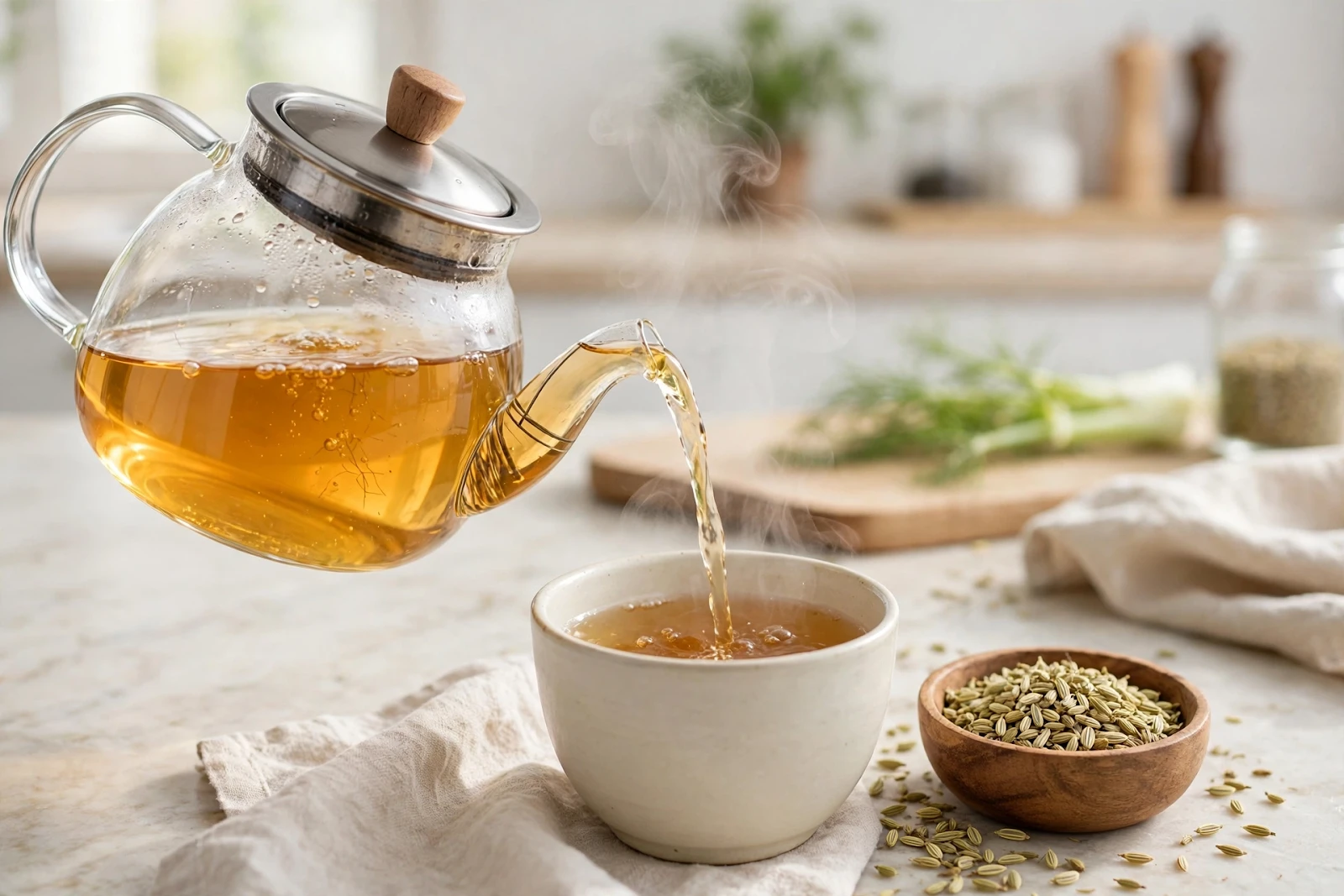
Illustration: A glass teapot pouring fennel tea into a cup beside a bowl of dried fennel seeds.
5. Fennel Tea and Relaxation
Part of fennel tea's appeal has nothing to do with digestion at all: it is a calming drink. It is caffeine-free, warm, and mildly sweet, and those three qualities alone make it a natural choice for the evening. Many people use it as a wind-down drink, a replacement for a final cup of coffee or black tea, or simply as a reason to sit down for ten quiet minutes. The ritual itself — boiling the kettle, waiting for the seeds to steep, holding a warm cup — can be genuinely relaxing, and that relaxation is a real benefit even if it is hard to measure in a laboratory.
There is also some interest in whether fennel's compounds have a direct calming effect, but the evidence is preliminary and mostly comes from animal or laboratory studies, which do not translate directly to a cup of tea. No reputable health authority describes fennel tea as a treatment for anxiety, stress, or insomnia. What is fair to say is that a caffeine-free, warm drink in the evening may support better sleep habits by replacing stimulating drinks and by giving the day a gentle closing ritual.
If you are building an evening routine, fennel tea fits easily alongside other simple habits: dimming bright lights, putting the phone away, and keeping the bedroom cool and dark. None of these habits is a cure for poor sleep, and anyone with persistent sleep problems should speak to a healthcare professional rather than relying on herbal drinks. But for people who simply want a pleasant, non-stimulating drink before bed, fennel tea is a sensible choice — and its mild sweetness means most people enjoy it without added sugar, which is an advantage at any time of day.
Parents sometimes ask whether fennel tea is suitable for children. The answer requires caution: concentrated herbal preparations are different from food, and children's bodies process plant compounds differently from adults. Fennel tea should not be given to babies or young children as a remedy for colic or any other condition without a doctor's advice. For older children, an occasional weak cup is generally viewed as low risk, but check with a paediatrician first, especially if the child takes medication or has allergies.
6. Fennel Tea for Hydration and Everyday Wellness
One of the simplest and most reliable benefits of fennel tea is also the least dramatic: it helps you drink more water. Most adults do not drink as much fluid as they should, and plain water can feel boring. A flavoured, caffeine-free infusion makes hydration more appealing, and every cup contributes to your daily fluid intake. Health organisations such as the WHO and the NHS emphasise that staying hydrated supports normal bodily functions, from regulating body temperature to helping the kidneys work efficiently. Fennel tea is simply one pleasant way to get there.
Because fennel tea is naturally free of caffeine and sugar when brewed plain, it avoids two common downsides of other popular drinks. It will not add to your daily sugar intake, and it will not make you feel jittery or interfere with sleep. That makes it a useful swap for people trying to cut back on sugary drinks or on caffeine in the afternoon. Replacing a sweetened soft drink or a late coffee with a cup of fennel tea is a small change, but small changes repeated daily are often the ones that last — and they tend to matter more than any single "superfood" habit.
There is also a social side to fennel tea that deserves a mention. In many cultures, offering a guest a cup after a meal is a gesture of hospitality, and sharing a drink is a moment of connection. Wellness is not only about nutrients; it is also about routines, relationships, and small pleasures — and a drink that encourages you to slow down contributes to wellbeing in a way that is easy to feel, even if it is hard to measure.
7. How to Brew Fennel Tea at Home
Brewing fennel tea at home is simple, and the quality of the result depends mostly on the freshness of the seeds. Start with whole fennel seeds rather than pre-ground powder: whole seeds keep their aromatic oils longer and give a cleaner flavour. Look for seeds that are greenish-yellow, fragrant when crushed between your fingers, and free of dust or debris. Store them in an airtight jar away from light and heat, and try to use them within six months for the best flavour.
The basic method uses about one to two teaspoons of fennel seeds per cup of water. Lightly crush the seeds with the flat side of a knife or in a mortar — this helps release the aromatic oils without turning the seeds into powder. Place the crushed seeds in a cup or teapot, pour over freshly boiled water, cover, and let it steep for five to ten minutes. A longer steep produces a stronger, sweeter flavour; a shorter steep is lighter and more delicate. Strain the seeds out before drinking, and taste the tea plain before deciding whether to add anything.
There are many pleasant variations. A slice of fresh ginger adds warmth and pairs well with fennel after a rich meal. A squeeze of lemon brightens the flavour, while a few fresh mint leaves make the tea feel cooler. A small amount of honey can be added if you prefer a sweeter drink, though many people find the natural sweetness of fennel is enough. For a cold version, brew the tea double strength, let it cool, and pour it over ice with a slice of lemon.
How much fennel tea is reasonable in a day? For most healthy adults, one to three cups a day is commonly suggested as a moderate amount. There is no official recommended intake, because fennel tea is a food and a traditional drink rather than a medicine with a defined dose. Moderation is the sensible rule: enjoy it as part of a varied diet, not as a large-volume daily habit, and avoid concentrated fennel oil or fennel supplements unless a healthcare professional has advised them. The essential oil is far more concentrated than the tea and is not interchangeable with it.
Finally, remember that quality matters more than quantity. A fresh batch of seeds, clean water, and a few minutes of patience will give you a better cup than any expensive gadget. If you buy fennel tea bags, choose a brand that lists fennel as the main ingredient and check the expiry date — stale tea bags make a weak, flat drink.

Illustration: A cup of fennel tea on a side table in a calm evening living room.
Myths vs Facts
Myth: Fennel tea is a medicine that cures digestive problems.
Fact: Fennel tea is a traditional drink, not a medicine. It may help some people feel more comfortable after meals, but it has not been proven to treat or cure any digestive condition, and it should never replace medical care for persistent symptoms.
Myth: Fennel tea detoxes your liver and flushes toxins from your body.
Fact: The liver and kidneys already remove waste products from the body, and no tea can speed up or replace that process. Fennel tea supports hydration, which helps the body function normally, but "detox" claims are marketing language, not science.
Myth: Because fennel tea is natural, it is safe for everyone in any amount.
Fact: Natural does not always mean safe. Fennel in medicinal amounts is not recommended during pregnancy, it may interact with some medicines, and concentrated fennel oil is very different from a cup of tea. Most healthy adults can enjoy moderate amounts, but anyone who is pregnant, breastfeeding, or taking medication should check with a doctor first.
Myth: Fennel tea helps you lose weight on its own.
Fact: Fennel tea is very low in calories, so swapping it for a sugary drink can support a healthy eating pattern. But the tea itself does not burn fat or cause weight loss. Lasting weight management depends on overall diet, physical activity, and sleep — not on any single drink.
Myth: Fennel tea and fennel bulb tea are the same thing.
Fact: Fennel seed tea is made from the dried seeds of the common fennel plant, while Florence fennel is a different variety grown for its bulb as a vegetable. The bulb can be brewed, but the flavour and the traditional uses are different, and most recipes and studies refer to the seed infusion.
When to See a Doctor
Fennel tea is a food drink, not a treatment, and it is important to know when a symptom needs professional attention rather than a home remedy. See a doctor promptly if you have digestive symptoms that are persistent, severe, or getting worse — for example, ongoing abdominal pain, bloating that does not ease, unexplained weight loss, difficulty swallowing, or blood in your stool or vomit. These symptoms can have many causes, and only a proper assessment can identify them.
You should also speak to a healthcare professional before drinking fennel tea regularly if you are pregnant or breastfeeding, if you take prescription medicines, or if you have a hormone-sensitive condition. Fennel contains compounds that may have mild oestrogen-like activity, and while the amounts in a cup of tea are small, the effects in medicinal doses are not well studied. People with allergies to plants in the carrot family — such as celery, carrot, or mugwort — should also be cautious, as cross-reactions are possible. If you ever develop a rash, swelling, or difficulty breathing after drinking fennel tea, stop drinking it and seek medical help straight away.
Finally, remember that this article is general information, not personal advice. Your health history, medicines, and circumstances are unique to you, and a qualified healthcare professional is the right person to help you decide whether fennel tea fits into your routine. When in doubt, ask — a short conversation with your doctor is worth far more than any article, including this one.
Sponsored: check today's offers on recommended wellness products
Frequently Asked Questions
Is fennel tea safe to drink every day?
For most healthy adults, one to three cups of fennel tea a day is generally considered a moderate, low-risk habit. There is no official daily limit, because fennel tea is a food drink rather than a medicine. If you are pregnant, breastfeeding, taking medication, or living with a health condition, check with your doctor before making it a daily habit.
Does fennel tea contain caffeine?
No. Fennel tea is a herbal infusion made from seeds, not from the tea plant, so it is naturally caffeine-free. That makes it a suitable choice in the evening or for people who are reducing their caffeine intake.
Can fennel tea help with bloating?
It may help some people feel more comfortable after a meal, and fennel has a long traditional reputation as a carminative — a substance believed to help release trapped gas. However, the scientific evidence is limited, and fennel tea has not been proven to relieve bloating. If bloating is frequent or severe, speak to a doctor.
Is fennel tea safe during pregnancy?
Fennel used as a food flavouring in normal amounts is generally considered low risk, but fennel tea in medicinal amounts is not recommended during pregnancy, because its safety in larger doses has not been established. If you are pregnant and considering fennel tea, ask your doctor or midwife first.
How do I make fennel tea taste better?
Start with fresh, whole seeds, crushed lightly and steeped for five to ten minutes — stale seeds make a flat drink. Ginger, lemon, or mint can brighten the flavour, and a little honey can be added if you prefer it sweeter. Most people enjoy it plain once they find the strength they like.
Have you tried fennel tea? Share your favourite way to brew it in the comments below.
Disclaimer: This article is for general information only and is not medical advice. It is not intended to diagnose, treat, cure, or prevent any disease. Always consult a qualified healthcare professional before making changes to your diet or health routine, especially if you are pregnant, breastfeeding, taking medication, or living with a health condition.


Comments
Post a Comment